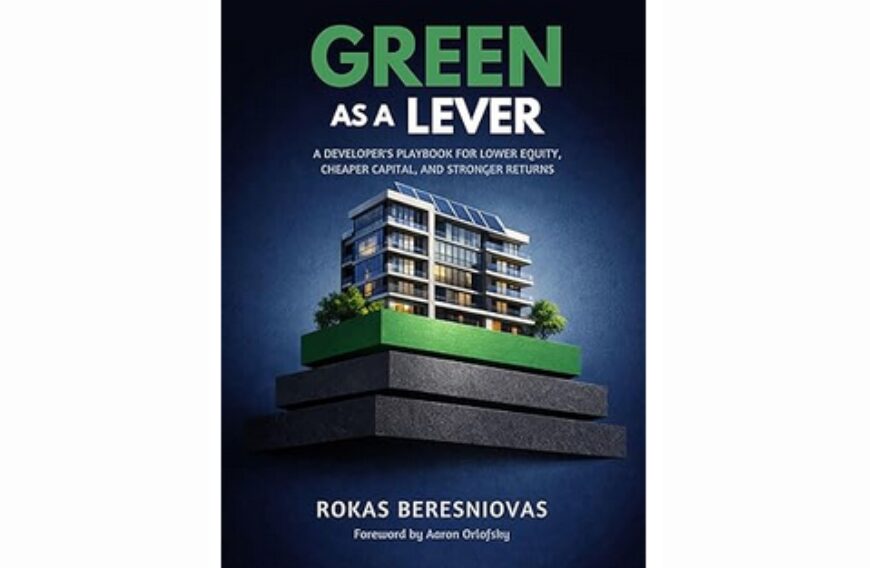
For nearly a decade, Rokas Beresniovas has contributed columns to The American Bazaar, writing on business, finance, and sustainability. With over 20 years in finance—and now serving as Head of Partnerships at the Montgomery County Green Bank—he is set to publish his new book, “Green as a Lever: A Developer’s Playbook for Lower Equity, Cheaper Capital, and Stronger Returns,” on April 19, available for preorder on Amazon Kindle.
Ahead of the release, The American Bazaar sat down with him to understand what prompted him to write the book.
You have been writing for The American Bazaar for nearly a decade. How did a column become a book?
It was an accident, really. I have been contributing articles to The American Bazaar since 2016 — short pieces on finance, sustainability, banking, whatever was on my mind. One day I sat down to write another column about how capital structures were failing multifamily developers, and ten pages in I stopped and thought — this is not an article. This could be a book. That was the moment.
The funny thing is, I am not someone who naturally loves to write or even to read. I think I have undiagnosed ADHD, and sitting with long text has never come easy to me. But something about writing this material was different. It helped me focus. It helped me organize what I had been seeing in deals for years. And honestly, it helped with my stress and my mental health in ways I did not expect. I would finish a writing session and feel genuinely better. So the book kept growing — not because I set out to write one, but because the process itself was giving me something I needed.
You argue that real estate does not have a sustainability problem — it has a capital problem. What do you mean by that?
Most people assume the barrier to better buildings is awareness, or willpower, or technology. It is none of those things. Developers know how to build high-performing properties. The problem is that the capital stack will not let them. Too much equity. Too much short-term debt. Capital structures designed for buildings that no longer exist.