Written by Rokas Beresniovas
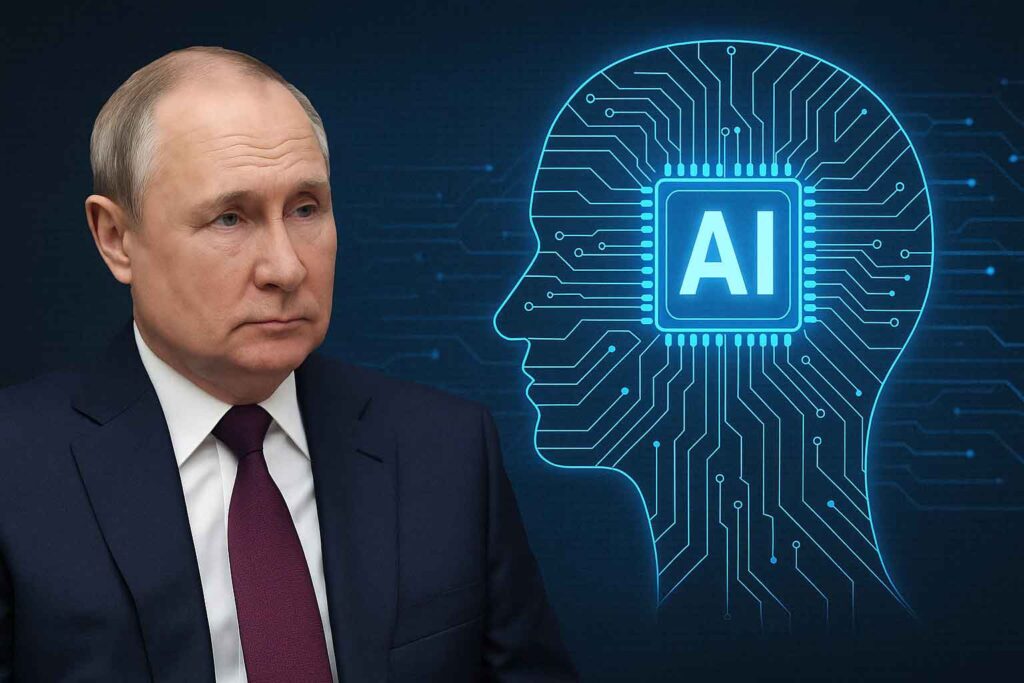
A few days ago, Vladimir Putin declared that Russia will lose its sovereignty unless it creates artificial intelligence based on Russian culture, history, linguistic wealth, traditions, and traditional values.
On the surface, the statement sounded like a call for technological self-determination. In reality, it was another example of how the Kremlin uses fear, isolation, and the idea of “sovereignty” as political instruments. Whenever Russia faces stagnation, repression, or public discontent, the same refrain emerges: “The West wants to destroy us.”
For decades, the word “sovereignty” has served as a sacred totem of Russian state rhetoric — a justification for every authoritarian reflex. It’s been used so often, and so cynically, that it has lost its meaning. It no longer describes the collective independence of a nation; instead, it signifies the unlimited power of those who rule it.
Each time Russia experiences economic pain or social unrest, the regime deploys the language of existential threat. Citizens are told that the country’s very survival depends on unity, obedience, and the rejection of foreign ideas. To question the government becomes to betray the motherland.
Rokas Beresniovas: Carbon capture is not a climate solution—it’s a fossil fuel lifeline (May 31, 2025)
As former Russian politician Nikolai Travkin recently observed, the more this rhetoric is repeated, the emptier it becomes: “As soon as any discontent begins to emerge among the people due to worsening living conditions, the authorities immediately cry out: ‘The West is encroaching on our sovereignty!’ They’ve used the word so often that the question ‘What benefit does this sovereignty bring me, an ordinary person?’ never arises.”
Travkin’s point exposes the hollowness of the state’s moral claim. True national interest should reflect the interests of citizens, not rulers. It should mean the right to live without upheavals, to have good healthcare and education, to pursue culture, science, and art; to breathe clean air, and to live freely and securely. In that sense, sovereignty is meaningful only when it protects human dignity and the pursuit of happiness. When it becomes a slogan for unchecked authority, it transforms into its opposite — a tool of subjugation rather than liberation.
That’s why Putin’s statement about creating an “AI based on Russian culture and traditional values” is revealing. It’s not about technology at all. It’s about control. Artificial intelligence, by its nature, thrives on openness — on global data, collaboration, and the exchange of ideas. To insist that AI be “rooted in Russian tradition” is to preemptively cage it, to declare that even machines must serve ideology. It’s a signal that innovation will be filtered through politics and that truth — even algorithmic truth — must remain loyal to the state. In this framing, AI is not a frontier of science; it’s a new frontier of propaganda. The goal isn’t to advance discovery but to ensure that the digital mind, like the human one, repeats the official narrative. Putin’s fear is not that Russia will lose its sovereignty. His fear is that it will lose control over how reality itself is defined.
Beyond the politics lies a more pragmatic contradiction — one rooted in energy and infrastructure. Artificial intelligence requires extraordinary computational power, and with it, extraordinary amounts of energy. Training large-scale models demands efficient grids, resilient data centers, and increasingly, clean and renewable energy.
Rokas Beresniovas: Green, clean, or just real? Rethinking our climate vocabulary (May 16, 2025)
In the United States and Europe, the AI revolution has gone hand-in-hand with massive investments in energy efficiency, grid modernization, and renewable generation. The world’s leading AI companies are also among the largest corporate buyers of solar, wind, and geothermal power. They understand that the future of intelligence — human or artificial — will depend on sustainable energy. Russia, by contrast, has done almost nothing to prepare for that reality. Its economy remains deeply dependent on fossil-fuel exports, while domestic energy infrastructure lags decades behind. Investment in renewables and efficiency has been negligible.
The country has neither the physical nor financial ecosystem required to build the kind of high-density, low-carbon data infrastructure AI demands. You can’t build 21st-century intelligence on 20th-century energy. For all its talk of technological independence, Russia’s AI ambitions are built on fragile foundations: inefficient grids, decaying transmission networks, and a near-total absence of private-sector investment in clean energy. Even if Russia were to produce advanced algorithms, the energy cost of training them would make any large-scale development unsustainable. If sovereignty is to mean anything in the technological realm, it must include energy sovereignty — the capacity to power innovation cleanly and reliably. Without that, the rhetoric of “AI rooted in tradition” becomes not only ideological but physically hollow.
What makes this rhetoric powerful is that it taps into real historical trauma. Russia’s collective memory is filled with invasions, revolutions, and humiliations. The concept of sovereignty thus carries deep emotional resonance. It’s easy to mobilize and hard to question. Yet, as Travkin reminds, when sovereignty becomes equated with the absolute rule of one man, it ceases to serve the people. It becomes a permission slip for unaccountable power: “Don’t you dare tell us from the outside what to do with our people — we are a sovereign state.” This mindset isolates not just the country from the world, but also its citizens from their own agency. When sovereignty must be defended at all costs — even at the expense of freedom, progress, and truth — it turns inward, consuming itself. The result is a society locked in a permanent defensive crouch, fearing change as much as it fears the outside world.
Rokas Beresniovas: Green, clean, or just real? Rethinking our climate vocabulary (May 16, 2025)
And that is the true paradox: sovereignty, once stripped of meaning, becomes fear itself — fear of openness, fear of innovation, fear of one’s own people.
When I listened to Putin’s speech, I wasn’t struck by its content — we’ve heard it all before — but by how seamlessly “AI” had been absorbed into the old nationalist lexicon. Technology is supposed to expand horizons; in this narrative, it closes them. The Kremlin’s version of AI isn’t meant to make Russia more competitive or creative. It’s designed to make control more efficient — to ensure that the algorithm never questions authority. “Traditional values” become the new firewall: the invisible code that keeps the machine from learning anything subversive. There’s tragic irony here. The country that once produced some of the world’s greatest scientists, mathematicians, and engineers now treats knowledge as a threat. The state that once dreamed of conquering space now fears the free flow of information.
Travkin ends his reflection with a quiet but devastating question: What good is sovereignty if it brings nothing to ordinary people? That question deserves to echo far beyond Russia. Every society that invokes “national values” to justify censorship, isolation, or intolerance should confront it. Sovereignty without freedom is just another form of dependency — dependency on fear, on propaganda, on the myth of external enemies. Putin’s speech may have been about artificial intelligence, but its subtext was the same as always: Without me, there is no Russia. It’s the oldest line in the autocrat’s playbook.
Read more columns by Rokas Beresniovas
True sovereignty doesn’t come from algorithms trained on “traditional values.” It comes from people empowered to think freely, to speak openly, and to imagine a future not defined by fear.
And perhaps that’s the one kind of intelligence — human or artificial — that authoritarian systems will never be able to replicate.